
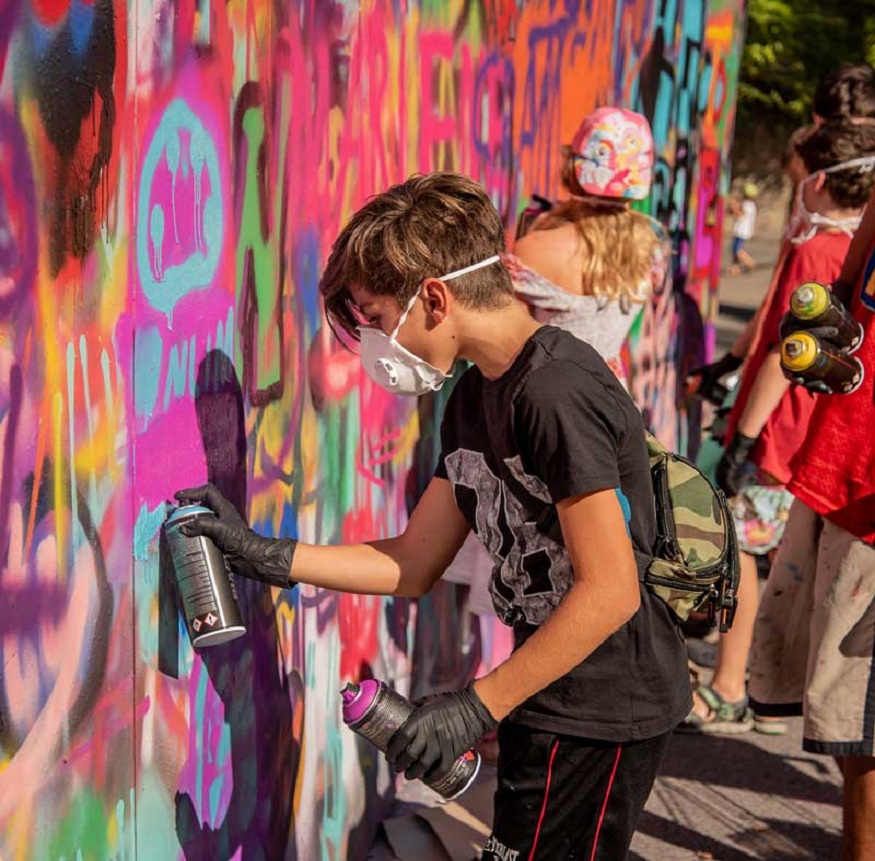
Graffiti is a form of visual communication
Graffiti is often approached as a visual style, but at its core it is also a form of communication. A name, letter or symbol is transformed so that it carries more than its literal meaning. Shape, scale, colour, spacing and rhythm all influence how the viewer experiences the image.
That makes graffiti surprisingly relevant to visual communication and design education. Students do not need to start with formal design theory to understand these principles. They can encounter them directly by changing a letter, moving an element or comparing how different colour combinations affect the same composition.
Why letters are such a powerful starting point
Graffiti lettering provides a practical way to explore the relationship between language and image. A word begins as information that can be read, but the artist gradually turns it into a visual object. Letters can be stretched, compressed, connected, layered and surrounded by outlines or shadows while still remaining recognisable.
Read More : Why New Manager Training Is Critical for Long Term Team Success
This process is closely related to the questions faced by graphic designers: how should information be arranged, what should attract attention first, and how can visual form reinforce meaning? A graffiti piece makes those questions visible on a large scale.
Typography becomes something you can see and feel
Working physically with letters also changes the learning experience. On a screen, students can move elements with a mouse and undo a decision instantly. With spray paint, movement, timing and proportion matter in a more immediate way. The surface records each choice, which encourages students to think before making the next one.
Colour is more than decoration
Colour is another area in which graffiti naturally introduces design thinking. Choosing colours is not only a matter of personal preference. Contrast, saturation and relationships between colours can determine whether letters stand out, disappear into the background or compete with other elements.
During a graffiti project, these effects become visible almost immediately. A dark outline may make a bright colour stronger, while two similar tones can reduce the clarity of a letter. Students can therefore learn about contrast and colour relationships through direct comparison rather than only through theoretical explanation.
The same principles apply to graphic design, branding, illustration and digital interfaces. Graffiti provides a physical and highly visual way to explore them.
Composition turns separate elements into a design
A strong graffiti piece is rarely just a collection of large letters. The artist has to decide how those letters occupy the available space and how different elements relate to one another. The composition may need a dominant area, supporting shapes, empty space and a clear visual direction.
This is where graffiti can introduce students to composition in a very practical way. Moving a word slightly, changing its scale or adding a second colour can alter the balance of the whole image. Students can experiment with those relationships while seeing the consequences immediately.
For an educational project, the process can become a useful exercise in visual problem-solving. There is often no single correct layout, but some choices communicate more clearly than others.
The design process starts before the spray can
One misconception about graffiti is that the creative process begins when the artist starts spraying. In practice, many pieces begin with an idea, a sketch or at least a mental plan. Thinking about the composition before working on the final surface can save time and make the result more coherent.
This planning stage creates a natural connection with design thinking. Students can define what they want to communicate, explore alternatives, choose a direction and then test it on the final surface. A professional workshop can make that process visible by separating sketching, technique practice and the final painting stage.
That structure is particularly useful for students who are more comfortable with planning than with spontaneous drawing. They can build an idea step by step rather than feeling that they have to produce a finished image immediately.
Learning through constraints
Creative work is sometimes misunderstood as having no rules. In reality, constraints can make creative decisions easier because they define the problem that needs to be solved. A limited number of colours, a fixed panel size or a specific word can give students a clear framework within which they can experiment.
Graffiti is naturally suited to this kind of exercise. A class can work with the same word while allowing every student to interpret it differently, or a group can share a colour palette while developing different lettering styles. The common constraint creates a basis for comparison without forcing identical results.
This can also make feedback more meaningful. Students can discuss why two different solutions work and which visual decisions create the strongest communication.
What a graffiti workshop adds to design education
A workshop turns these ideas into an experience rather than leaving them at the level of theory. Participants learn how the spray can behaves, how letters can be constructed and how colour and composition change the final image. They also have to make decisions in real time, often while working alongside other people.
A professional graffiti workshop can therefore function as an introduction to several connected skills at once. The activity is still enjoyable and accessible, but beneath the finished artwork are lessons about visual hierarchy, typography, materials and decision-making.
For students who mainly encounter design through computers and digital tools, working with aerosol paint can be particularly revealing. Physical limitations become part of the design problem rather than something that software automatically solves.
From physical graffiti to digital design
The relationship between graffiti and digital design is closer than it may first appear. Graffiti artists think about letterforms, contrast, scale, layering and composition, while digital designers use many of the same principles on screens. The tools are different, but the visual decisions overlap.
This makes graffiti an interesting bridge between traditional and digital creativity. Students can create a physical piece and then photograph or digitise it, compare the original with a digital version and consider how the artwork changes when it moves into another medium.
The process can also introduce questions about reproduction and adaptation. A design that works on a large wall may need to be changed for a small screen, just as a digital graphic may need adjustment when translated into a physical mural.
Creativity and technical control belong together
Graffiti is sometimes presented as spontaneous expression, but technique plays a large role in making an idea work. Spray distance, pressure, movement and cap choice all influence the result. Without a basic level of control, the artist may struggle to reproduce the visual idea in their head.
This relationship between creativity and technique is valuable in education. Students learn that having an idea is only the beginning. They also need to understand the tools well enough to communicate it. Practice is what gradually reduces the distance between intention and result.
That lesson applies to drawing, photography, filmmaking, graphic design and many other creative disciplines. Graffiti simply makes the relationship particularly visible.
A different way to understand street art
Graffiti can also teach students to look differently at the visual environment around them. Once they understand lettering, spray techniques and composition, they may notice details in public artworks that previously went unnoticed.
They can begin to distinguish between different approaches to lettering, recognise the role of outlines and colour, and think about why an artist chose a particular wall or scale. The city becomes a visual learning environment rather than just a backdrop.
This broader awareness is one of the strongest educational arguments for using graffiti. The workshop does not end when the spray cans are put away; it can change how students interpret visual culture afterwards.
Why hands-on learning matters
The main strength of graffiti as an educational medium is that knowledge and action happen at the same time. Students can learn a principle, test it, see the outcome and adjust their approach within the same session. That immediate feedback is difficult to reproduce through explanation alone.
A hands-on project also gives students something concrete to discuss. They can explain why they chose a particular letter structure, why one colour was placed next to another or how they solved a composition problem. The finished artwork becomes evidence of the thinking process.
For education providers interested in creative learning, that combination of practical technique and visual reasoning makes graffiti more than an unusual art activity. It becomes a useful framework for exploring how design decisions are made.
Graffiti as a bridge between art and design
Graffiti sits in an interesting position between fine art, graphic design, popular culture and public space. It is visually immediate, but it also depends on structure. It can be spontaneous, yet experienced artists spend years developing technical control and personal style.
That combination makes it useful for teaching students that creativity is not a single skill. Good visual work often depends on observation, experimentation, planning, technical ability and the confidence to make choices.
Graffiti workshops bring those elements together in a format that feels contemporary and accessible. Students are not only learning how to use a spray can; they are learning how visual ideas can be constructed, communicated and adapted.
The role of a professional workshop
A professional graffiti workshop can therefore function as an introduction to several connected skills at once. The activity is still enjoyable and accessible, but beneath the finished artwork are lessons about visual hierarchy, typography, materials and decision-making.
Read More : How to Help Your Child Handle Peer Pressure at School
Graffitifunworld deliversstreetart- graffiti workshops for schools, companies and parties and other groups internationally, with the format adapted to the audience, location and experience level. Its worldwide workshop platform includes dedicated programmes for schools alongside other educational and creative formats.
For students, the result is not simply a piece of graffiti to take home or display. The more lasting outcome can be an understanding of how visual communication works and how creative ideas develop from concept to finished image.